Hip injuries in CrossFit
|

Have you ever suffered from hip discomfort? Do you practice CrossFit and your hip is bothering you? Any injury that has prevented you from practicing your favorite sport?
In this article, our physio Adrià Pie explains everything we need to know about this joint.
Anatomy and function
What is the hip?
The hip is the joint where the femur meets the pelvis. The head of the femur is connected to the acetabulum of the pelvis by various tissues such as ligaments, muscles, cartilage or labrum, tendons and joint capsule.

Hip joint
It is also known as coxofemoral joint. Due to its structure and characteristics, it is considered a synovial and spherical (or glenoid) joint, since it allows movements in different planes and axes (flexion/extension, adduction/abduction and rotations).

The coxofemoral joint is very stable and capable of bearing high loads. From very early stages of life, this joint shows a great congruence, since it has to receive mainly compressive and impact forces.
To give more congruence to the articulation, we have the labrumThe fibrocartilage, a fibrocartilage that increases the contact surface of the acetabulum and makes a seal over the femoral head, providing stability and preserving the synovial fluid in the central area of the joint.
Synovial fluid nourishes the joint.
In addition to the labrum, there are several ligaments in the hip that provide stability and control in certain movements and joint ranges.
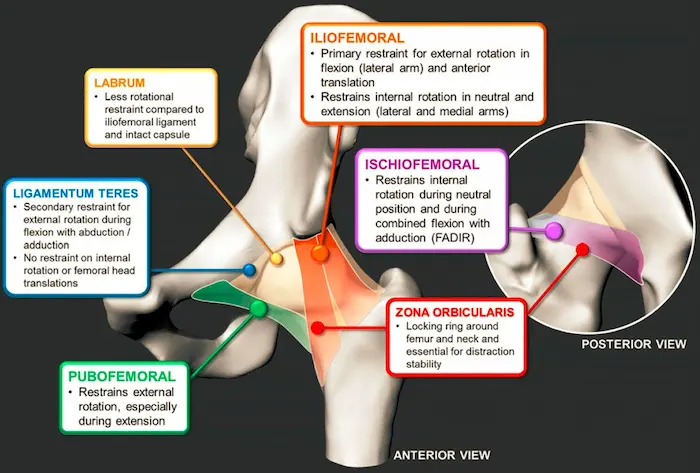
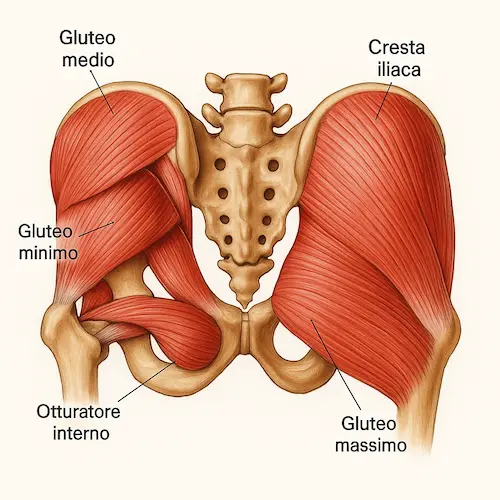
We find a large number of muscles in the hip area that allow us to perform the different movements. Some are larger and more powerful, such as the gluteus or rectus femoris, and others are smaller, such as the obturators.
The hip is intimately related to the lumbar, pelvis and lower extremities, the musculature involved in the movements of the hip joint has origin or insertion in these other areas.
Hip injuries
femoroacetabular impingement
The most common hip injury (or symptom) is the femoroacetabular impingement or femoroacetabular impingement (FAI).
It is an alteration related to hip movement and represents a premature and symptomatic contact between the femoral head and the acetabulum.
It is accompanied by a triad formed by the presence of symptoms, clinical signs and findings in imaging tests.
To diagnose FAIIn the case of the triad, the three components of the triad must be present.
The main symptom is pain related to the movement or position of the hip, usually located in the hip or pubis, although it can also occur in the lumbar, buttocks or thigh.
In addition to pain, patients may describe crepitus, locking sensation, stiffness or limitation of range of motion. Typically the restriction of motion is to internal rotation and hip flexion.
Tests for FAI usually reproduce the patient's pain. The most common is the FADIR test (hip flexion, adduction and internal rotation), which has a high sensitivity but no specificity.

Imaging tests are necessary to obtain a morphological view of the hip, being able to identify CAM or PINCER and other causes of hip pain. Cartilage or labral lesions should also be assessed.
Cam type and pincer type
There are two types of morphological alterations in the hip. In the cam type we find a hump in the femoral head that can collide with the acetabulum in hip flexion movements. In the pincer type we see an overgrowth of the acetabular rim that can rub against the femur in hip flexion and rotation movements.
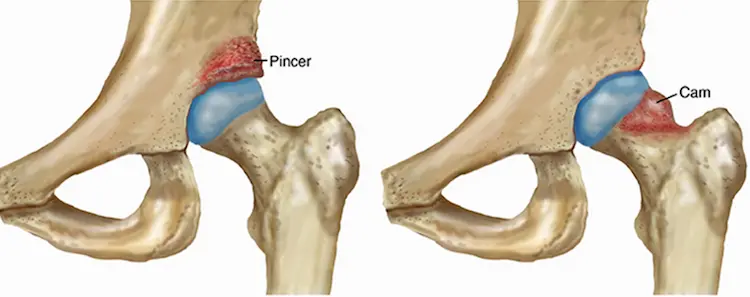
We can find one or both alterations. The cam type are usually more frequent in young patients and athletes. Mixed alterations (pincer + cam) are also common.
These alterations can also be found in asymptomatic patients, so it is very important to make a good assessment before making a diagnosis and choosing a treatment.
Likewise, in this type of patients who present some alteration but do not have symptoms, it is interesting to perform specific work and avoid certain movements or exercises that may end up causing pain.
Treatment
Treatment may be conservative or surgical.
Announced as the conservative treatment patient education is worked on, progress is monitored and advice is given to improve lifestyle and activities.
From the physiotherapy is intended to improve hip stability, neuromuscular control, strength, mobility and movement patterns. Adjusting to the demands of each patient.
The objective is to give the best possible control and stability to the hip joint through exercises that strengthen the muscles involved in the movements. At the same time, exercises and training load are modified to allow a correct adaptation.
In the surgeryThe objective is to improve the shape of the hip and repair the injured tissue.
Currently, the conservative option with physiotherapy treatment has demonstrated a high success rate, equal or superior to surgical treatment in the long term. In any case, it is essential to evaluate each case and take into account all the options.
Conceptual map for the diagnosis and treatment of FAI.
The hip in CrossFit
Mobility or strength limitations in the hip can adversely affect athletic performance and increase the risk of injury.
In CrossFit, the mobility and proper function of this joint is critically important. especially in movements that are based on the squat or hip hinge pattern.
The hip musculature, especially the gluteus medius, is also part of what we know as "core" or central part of the body. This area is responsible for providing stability to the trunk and allows us to apply force and move loads with a stable base.
Key points
Special attention to deep squatsespecially if you are not used to it.
Progress gradually so that the joint becomes accustomed to that range of motion and the musculature is strengthened to work properly in those ranges.
In Olympic movements such as the deadlift, we receive the weight with the inertia it carries in the front squat position, which can lead the hip to work at maximum flexion ranges.
It is important, once again, to progress correctly.
They are not harmful exercises but may take some time to adapt to them.
Focus on mobility work
Beware of stretching or "mobility" exercises.
It is necessary to individualize; the same exercise may work well for some and be counterproductive for others.
Some stretches or mobilizations can produce certain movements in the hip or lead to certain positions that can end up causing problems.
It's not all about working on mobility.
As we have seen, the hip can present morphological alterations, even in asymptomatic patients.
In addition, in some people will rank higher than others. Therefore, we should not be obsessed with having more and more mobility, but with achieving the necessary mobility and working on strength throughout the entire range. you have at your disposal.
As we gain strength and control, we will increase mobility.
If you have doubts or problems with any exercise, consult a physiotherapist specialized in sports to assess your case and develop an individualized plan.
Injuries and performance
In general, progressing with loads and exercises in the correct way is very important. so that the different structures and muscles of our body adapt to the training load and improve our capabilities (strength, mobility, muscle mass, endurance, ...).
Using regressions of the exercises (adapted or simpler versions), adjusting the weight with which we work, controlling the intensity of the workouts, ... are strategies that we can use to perform a better training. graded exposure of our body to exercise in the safest possible way.
The body needs time to adapt to new stimuli and also needs time to recover. Patience and proper rest is part of training and key to reducing the risk of injury.
Keeping track of your workouts can help you see how much load you have accumulated and when it would be convenient to slow down or take a break. It is also important to listen to the body to self-regulate the workout load (and leave the ego at home). It is too general
Exercises to strengthen the hip
Here are a series of exercises to improve hip strength, control and mobility:
Copenhagen plank hold
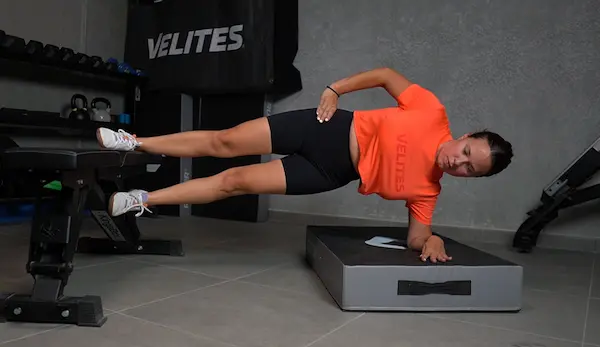
Copenhagen plank dynamic
Side lying adductor leg raise
Cossack squat
Psoas march
Plank psoas march
Wall drill psoas march
Hip lock + hip flexion weighted w/ KB or plate
Tempo back squat
The following image is accelerated but you should go down in a slow and controlled manner.
Pause back squat (bottom)
Same as the previous one but we keep the position below.
Squat with miniband

Overcoming isometric back squat
Glute Clamshells
Captain morgan hold
Seated hip internal rotation
Quadruped hip internal rotation
Hip thrust
One leg hip thrust
Pistol squat in assisted drawer
Pistol squat in crate
*If you feel discomfort when performing any of these exercises, consult your physiotherapist or trainer.
If you are looking to accelerate recovery and reduce muscle discomfort in the area, the red light therapy can help you. I leave you the complete analysis so you can see when to use it and what benefits it has.
Conclusions
It is important to know which exercises place the most demands on the hip joint, so that we can make good progress.
There are no exercises that are bad by nature, but it is necessary to individualize to avoid developing discomfort or pathologies.
There may be alterations in the hip, with or without symptoms. Other factors must be taken into account before making a diagnosis or treatment.
Hip problems can cause pain not only in the hip joint itself, but also in the lumbar, pubis, buttocks and thigh.
Mobility work seems to be overrated. It is better to focus on general strength work and those ranges we want to improve.
The treatment that seems to give the best results is the conservative one, although each case must be assessed on a case-by-case basis. Controlling the training load and developing an individualized exercise plan is key.